A European Classroom: Posters, Practice, Perspective
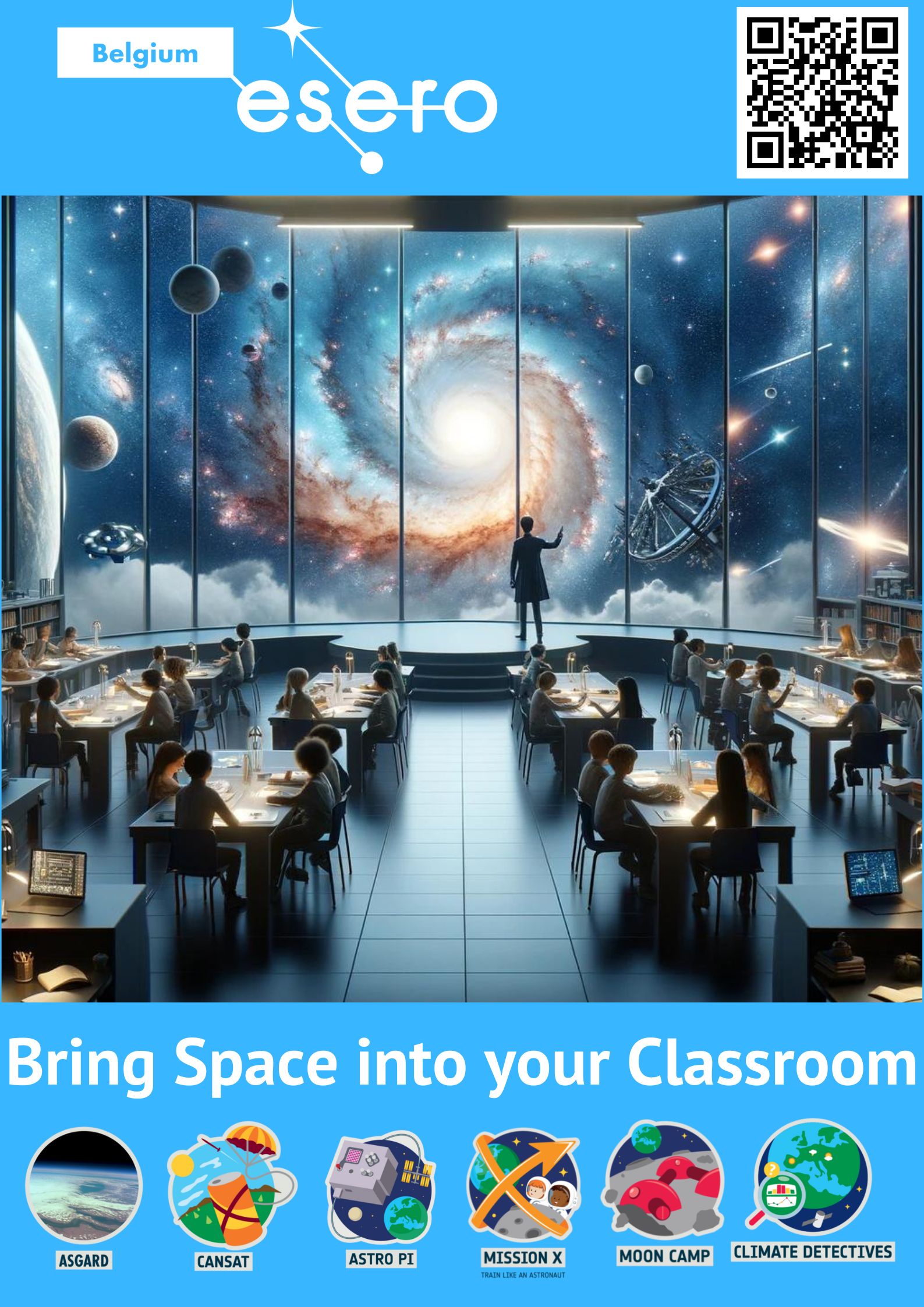
In March 2025, I found myself in Heureka, a Finnish science center. During the behind-the-scenes tour, the guide mentioned their temporary exhibition Our Journey in Space and asked if anyone knew about ESERO. Without thinking, I raised my hand: “I did a small project with ESERO Belgium,” I said. “We made a poster to bring space into the classroom.”
The guide shrugged. He didn’t know about it. That was frustrating, as being dismissed despite relevance, always is.
To me, that moment wasn’t about recognition. It was about connection: between three experiences that touched on how I think, how I teach, and how I make sense of complexity. A science communication course in Leuven, an intense BIP in Utrecht, and another BIP in Helsinki that led me to that very exhibition. Three spaces. Three versions of the same lesson: clarity matters.
Learning to Translate Science (Leuven, 2024)
When I took the Science Communication and Outreach course at KU Leuven during my Verkorte Educatieve Master Talen, I didn’t expect it to sharpen my thinking the way it did. The course asked us to reflect on what science means in society, and how communication can either bridge or break the link between experts and everyday people.
I’m a visual learner. Words alone don’t stick for me. So when we had to do a group project, my partner and I decided to make a poster.
We focused on ESERO Belgium’s programs: Astro Pi, CanSat, Moon Camp, Mission X, and more. We visited Charleroi for BigBangDay 2024 and heard astronaut Thomas Pesquet speak, a powerful moment for any space enthusiast, along with Zara Rutherford, the youngest woman to fly solo around the world at just 19. Those moments grounded our work. This wasn’t theory anymore. This was communication with purpose.
Our poster was designed for teachers, not students. It had links, QR codes, and a simple design. We printed it and put it in the teacher’s lounge. If someone was curious, they could scan the code and dive in on their own time. No pressure, just access.
From Theory to Fieldwork (Utrecht BIP, 2024)
A few weeks later, I was in Utrecht for a Blended Intensive Programme. It was chaos, the good kind. In a short time, we had to come up with a research question, observe a real classroom, gather data, and make sense of it. It was the first time I felt like I was doing actual problem-solving in an educational context. After years of study, this was the first time the wires sparked.
Our coach, a university professor, was brilliant. He didn’t talk down to us, but he didn’t leave us flailing either. He guided, nudged, and let us find our path. That intensity expanded my perspective. I still think about that.
And yes, our final output? A poster. Again. Visual, simple, direct. Just like in Leuven.
Seeing It Live (Heureka, 2025)
When I saw the space exhibition at Heureka, something clicked. I had been living inside this idea for a year: posters, QR codes, communication that respects the audience’s time and context. What I saw in that exhibit was what I had been trying to do in smaller ways.
During the backstage tour, I asked the guide whether Heureka aims to bring innovations from space into classrooms. He shrugged and said, “No. That’s not really our purpose.” Heureka is a science center. Its role isn’t classroom-specific.
Maybe not. But that’s what I had been trying to do.
Adapting for Attention (Helsinki BIP, 2025)
The theme of the BIP in Helsinki was Education in a Digital World. During one classroom observation, we spoke with a teacher about distraction and digital overload. She said something that stuck: “We’ve all lost our concentration. Even adults. But what’s the problem with that?” She wasn’t trying to fix attention. She was adapting to it.
“When I teach theory,” she added, “I keep it short.”
After Helsinki, I started doing the same. When I introduce grammar or theory in class now, I make short, visual PowerPoints. One idea per slide, minimal text, to the point. I usually say to my students, “Beautiful people, I need your attention for five to seven minutes. Then you can sleep, kidding!”
They laugh, but it works. That short burst of focus gives them what they need. Then they move on to reading, exercises, or group work.
It’s the same design logic I had practiced with posters and QR codes: clarity and brevity for busy teachers. In the classroom, I added one more ingredient, a bit of humor, when it fits.
Reflection
Since then, I’ve had the opportunity to become one of the admins of the ESERO Belgium Facebook page. It’s a small responsibility, but it’s meaningful to me because it shows that these projects had an impact.
Science communication taught me how to simplify. The BIP taught me how to problem-solve in intense environments. Helsinki taught me how to adapt my delivery.
Not from a textbook, but through design, visuals, story, and intent.
So yeah. The poster matters. The QR code matters. The five-minute theory slide matters.
But what really matters is learning to make things click for someone else. That’s what I’m taking with me.
You can also read the article here:
👉 A European Classroom: Posters, Practice, Perspective